
What the CV Filtering Process Involves
At an enterprise scale, the CV filtering process must be systematic. It is the critical bridge between candidate sourcing and final interviews. If this stage is flawed, your hiring managers will waste time interviewing the wrong people.
Stage-by-Stage Breakdown
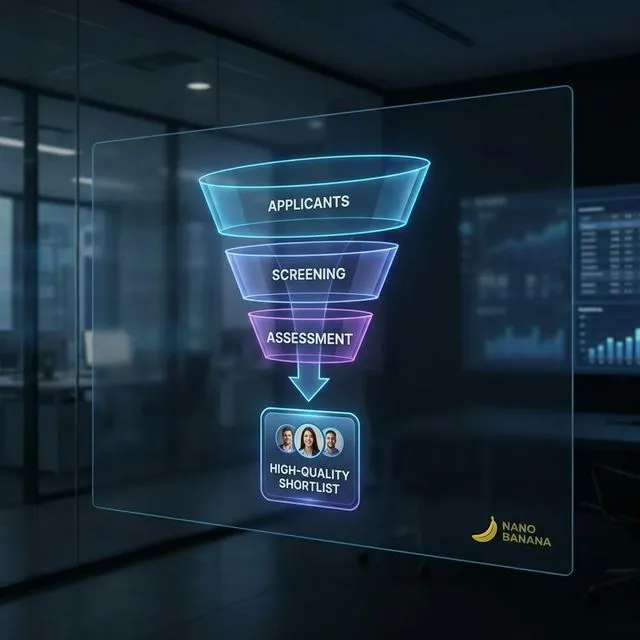
A mature, structured shortlisting framework follows these key stages:
- Defining Criteria: Before a single CV is read, the hiring team must establish the non-negotiable requirements (e.g., minimum cognitive baseline, specific verified qualifications).
- Screening: Assessing the applicant pool against the defined criteria. In a traditional process, this is where a human reads the resumes.
- Shortlisting: Ranking the candidates who passed the initial screening phase to identify the top tier for interviews.
- Handoff: Delivering a clean, defensible list of candidates to the hiring manager.
The Breakdown of Manual Filtering at Scale
Manual filtering breaks down rapidly when application volume increases. The pros of manual review (nuance, human intuition) are completely outweighed by the cons when dealing with 500+ applicants.
Fatigue leads to inconsistent screening. Unconscious bias creeps in. And crucially, filtering in CV text alone provides very low predictive validity for actual job performance. You end up assessing formatting skills, not core capability.
How Software Streamlines the Process
Upgrading to an automatic CV filtering software transforms this funnel.
When you use a CV filtering system like SkillsPassport, the screening and shortlisting stages happen simultaneously and instantaneously. Instead of reading CVs, candidates complete secure, proctored cognitive assessments up front. The system scores them, applies your predefined thresholds, and presents the hiring manager with a ranked shortlist.
Tips for Building a Better Filtering Process
- Measure what matters: Stop prioritising keyword matching. Assess underlying cognitive potential using verbal, numerical, and non-verbal reasoning tests.
- Verify identity early: Don't wait until the offer stage to realise a candidate's identity or qualifications don't match their claims. A robust CV filtering system incorporates ID verification and facial matching at the point of application.
- Build for compliance: Ensure your process is fully POPIA-compliant and supports your organisation's B-BBEE transformation goals through objective, data-driven candidate evaluation.
Ready to upgrade your workflow?
Stop managing chaos and start managing talent. See how an automated, methodology-first platform can transform your hiring speed and quality.
See How SkillsPassport Automates the Process →Frequently Asked Questions
Why is structured career guidance important?
Career guidance is critical because it aligns a learner's inherent cognitive abilities, personality, and interests with real-world economic opportunities, preventing costly academic mistakes and improving career satisfaction.
Who benefits from the SkillsPassport assessment?
Grade 9 learners choosing subjects, Grade 11/12 learners choosing tertiary studies or TVET options, and young adults seeking to transition into the workforce safely can all benefit.
How accurate is the SkillsPassport matching?
Our matching algorithm combines scientifically validated psychometric assessments with current higher education and TVET admission criteria to ensure completely aligned and actionable study routes.
Dr. Lanette Hattingh
HPCSA-registered Educational Psychologist | Founder, SkillsPassport
Expert in psychometric assessments, career guidance, and future-ready skills development. Dr. Hattingh designed the SkillsPassport assessment methodology used by 15,000+ learners across 100+ schools.
LinkedIn Profile